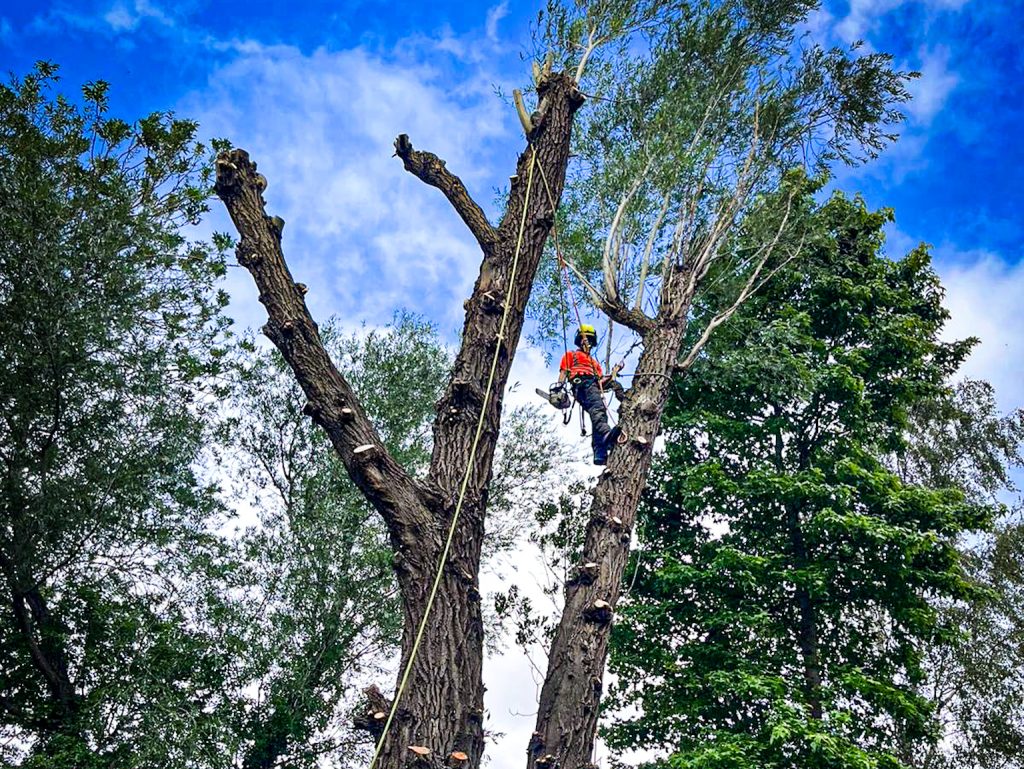





Tree Management Along the Great Stour in Kent
About Trees Ltd recently undertook a comprehensive domestic tree management project in Kent, along the Great Stour.
This picturesque area in southeast England is home to a diverse range of trees that require regular maintenance to ensure their health, safety and contribution to the landscape.
The project involved managing a number of different tree species along the Great Stour, with work including tree felling, pruning, pollarding and the removal of potentially hazardous branches and comes under our Canterbury and Ashford work areas.
The Objectives of the Tree Management Project
The primary objective was to maintain the health and safety of the privately owned trees along the Great Stour, while also improving the visual appearance of the area by managing their growth and structure.
Public and property safety were also important considerations, particularly where potentially hazardous trees or branches had been identified.
Where trees needed to be felled, the wood was retained and used in an environmentally friendly manner.
Tree Management Work Along the Great Stour
A number of different species required attention during the project, with each tree assessed individually and the work tailored accordingly.
Prunus avium (Wild Cherry)
Just over the footbridge on the right-hand side, on the edge of a newly cleared section, a multi-stemmed Wild Cherry was felled to ground level as it was considered unsafe. The wood was stacked along the bar and rail fence, marking the boundary.
Another Wild Cherry, which had previously been damaged by a falling cedar during storms, was also cut down to ground level to help prevent decay and any potential danger.
Salix fragilis (Crack Willow)
On the riverbank, near an Acer whip and Prunus, a small Crack Willow was felled to ground level to manage its growth and maintain the area’s ecological balance.
Liquidambar styraciflua (Sweet Gum)
On the same bank, near a stand of cherry trees, a gnarled Sweet Gum had a dead branch growing over the river. This was removed to prevent a potential accident.
Salix babylonica (Weeping Willow)
Near the neighbour’s bridge, a large Weeping Willow that had previously been pollarded was re-pollarded back to its previous points at approximately 8–9 metres above ground level.
This involved removing around 6–8 metres of growth from the branch tips. The wood was then stacked near the tree to provide ecological benefits.
Salix fragilis (Crack Willow)
Near the mooring spot for the rowboat, another mature Crack Willow was re-pollarded back to its previous points, with all adventitious growth cleared from the stems.
The resulting wood was stacked near the Weeping Willow.
Tilia cordata (Small-Leaved Lime)
On the field side of the western boundary, near the small brick bridge, the Small-Leaved Lime was pruned to open up the view.
An identified branch was reduced by four metres to a suitable upright growth point, improving the landscape’s appearance while managing the tree appropriately.
Acer negundo (Box Elder)
Also on the field side of the western boundary near the small brick bridge, a smaller secondary branch extending over the pond was removed to improve the vista.
Challenges of Riverside Tree Management in Kent
Access was one of the biggest considerations during this particular Kent tree management project.
Access to the neighbour’s garden was required so that brushwood could be processed and winched across the river. Ground conditions also significantly affected our ability to get vehicles close to the work area.
Given that the two large Willow trees were surrounded by ponds, the river and its tributaries, timing was critical.
The project had actually been in planning since September 2023, but the work could only commence when the ground conditions were sufficiently dry. This helped ensure minimal damage to the surrounding area and allowed the safe use of heavy machinery.
The location is prone to waterlogging, so careful movement was required to minimise damage to the ground. Working in these conditions required specialist off-road vehicles capable of navigating soft and potentially unstable terrain without causing excessive harm.
Safety was also paramount throughout the work, particularly when dealing with large trees and heavy branches. Strategic planning and careful timing played an important role in mitigating the risks associated with the tree management activities.
Completing the Tree Management Work
This project along the Great Stour was a comprehensive tree management project in Kent, designed to maintain the health, safety and visual appeal of the area.
By carefully selecting and carrying out the appropriate work for each tree, the project successfully balanced ecological considerations with aesthetic and safety requirements.
The use of felled wood in an environmentally friendly manner further demonstrated the project’s commitment to sustainability.
Ongoing Tree Management Recommendations
Following the work, we recommended implementing a regular monitoring schedule so that any potentially hazardous trees or branches can be identified and addressed early.
We also recommended continued engagement with local neighbours regarding future tree management activities, helping to foster a sense of stewardship around the area.
Sustainable practices for wood disposal and ongoing tree maintenance should also continue wherever possible to enhance the ecological benefits of future work.
This case study demonstrates the expertise and detailed planning involved in professional tree management in Kent, particularly on sites where mature trees, rivers, ponds, difficult access and sensitive ground conditions all need to be taken into consideration.
By carefully planning and carrying out the work, the natural beauty and safety of this part of the Great Stour can be preserved for future generations.